
When module manufacturers evaluate cell suppliers, conversations tend to focus on efficiency percentages and technology type — TOPCon versus HJT, n-type versus p-type. But there’s a quieter factor that often determines whether a sourcing relationship actually works in practice: physical format compatibility. The 210R cell format has become one of the most important standardization points in the industry, and it’s worth understanding why.
What “210R” Actually Means
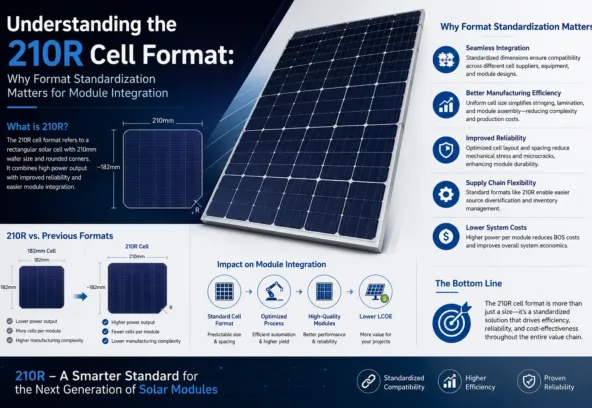
The number refers to the wafer size — 210mm — which is one of two large-format wafer standards (alongside 182mm) that have come to dominate the industry after the wafer-size fragmentation of the early 2020s. The “R” denotes a rectangular cut of that wafer, as opposed to a full square format. This rectangular cut allows manufacturers to optimize cell dimensions for specific module layouts without the wasted silicon that comes from cutting smaller cells out of a full 210mm square.
In practical terms, 210R cells offer a middle ground: larger than 182mm cells (more power per cell, fewer interconnections needed per module), while avoiding some of the handling and cracking risk associated with full 210mm square cells in high-speed assembly lines.
Why Format Standardization Became a Competitive Issue
In the early years of the n-type transition, the industry briefly fragmented across multiple wafer sizes — 156mm, 166mm, 182mm, 210mm, and various rectangular cuts — as manufacturers raced to differentiate. That fragmentation created real problems downstream: module manufacturers had to either commit to a single wafer size across their entire product line (limiting supplier flexibility) or maintain multiple parallel assembly configurations (adding cost and complexity).
The market has since consolidated heavily around 182mm and 210mm formats, with 210R emerging as a widely adopted middle path. Trina Solar, one of the larger players in the global module market, has been particularly influential in pushing 210 and 210R format standardization — to the point where compatibility with this format is now something many module manufacturers actively look for when evaluating new cell suppliers, simply because it reduces the integration risk of switching vendors.
What Format Compatibility Actually Saves You
If you’re running an assembly line calibrated for a specific cell format, switching suppliers to a different format isn’t a simple swap. It can mean:
- Recalibrating stringing and tabbing equipment
- Adjusting module layout and frame dimensions
- Requalifying the bill of materials for certification purposes
- Potential delays in production while the line is reconfigured
A cell supplier offering a widely standardized format like 210R reduces or eliminates these switching costs. This matters most in two scenarios: when you’re adding a second supplier to diversify your supply chain (a growing priority for many manufacturers given recent trade policy shifts), or when you’re scaling production and need a supplier who can match your existing line configuration without retooling.
Power Output and Efficiency Considerations
Larger cell formats generally deliver higher power output per cell, which translates into fewer cells needed per module and, by extension, fewer interconnections — each of which is a potential point of resistance loss or failure over the module’s lifetime. The 210R format strikes a particular balance here: enough surface area to maximize power density, while the rectangular cut keeps individual cell handling more manageable during high-speed automated assembly compared to full square 210mm cells.
For module manufacturers targeting commercial and utility-scale segments — where power density per square meter directly affects project economics — this combination of high output and manageable handling characteristics has made 210R a practical default rather than a niche choice.
What to Ask Your Cell Supplier About Format
If you’re sourcing cells and format compatibility matters to your line, a few practical questions are worth raising directly:
- What exact dimensions and tolerances does the supplier guarantee, and do they match your existing module specifications precisely, not just approximately?
- Is the format consistent across production batches, or does the supplier produce multiple formats on the same line with potential for mix-ups?
- Does the supplier have documentation or third-party certification confirming format specifications for your own quality assurance and customer-facing documentation?
These aren’t abstract concerns — format mismatches discovered after a shipment arrives are expensive to fix and can delay project timelines significantly.
PTECH Solar’s 210R Production
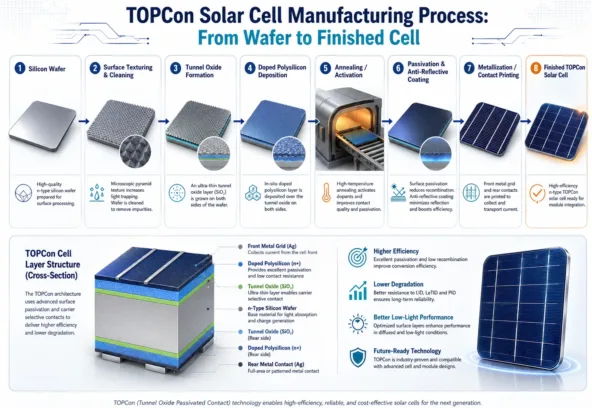
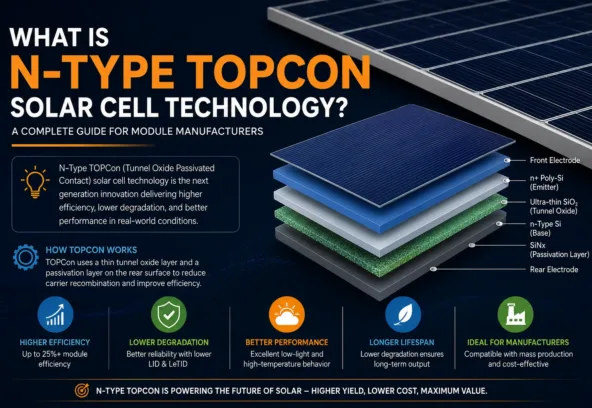
PTECH Solar manufactures n-type TOPCon cells in the 210R format at our facility in Düzce, Turkey. This format choice was deliberate: 210R compatibility means module manufacturers already calibrated for this widely adopted standard can integrate our cells without retooling their assembly lines — whether they’re adding us as a primary supplier or diversifying their existing supply chain.
We provide full dimensional documentation and samples for manufacturers evaluating format compatibility before committing to larger orders.
This article is part of PTECH Solar’s technical resource series for module manufacturers and B2B solar buyers. For questions about our N-type TOPCon 210R cells, visit ptechsolar.com.