
If you manufacture solar modules and you’re evaluating cell suppliers, you’ve likely run into one term constantly: TOPCon. It dominates supplier pitches, technical spec sheets, and industry conferences. But what is it, exactly, and why has it become the default choice for most module producers moving away from PERC?
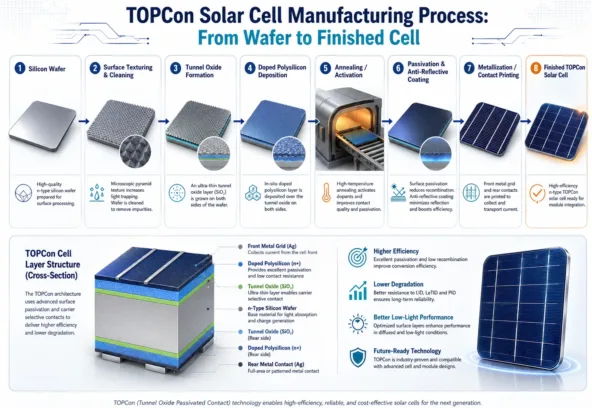
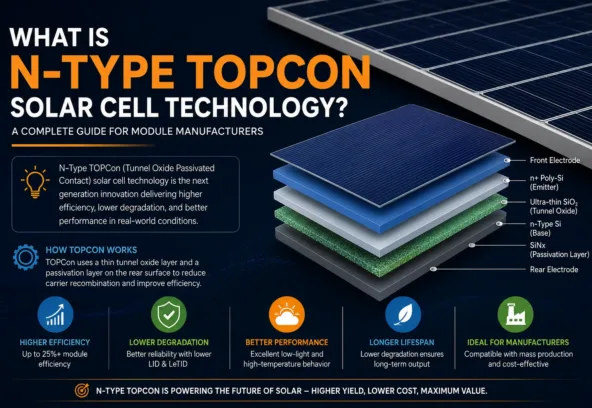
TOPCon (Tunnel Oxide Passivated Contact) is an n-type solar cell technology that uses an ultra-thin silicon oxide layer combined with a doped polysilicon layer on the rear of the cell. This structure reduces recombination losses at the cell’s surface, which translates directly into higher open-circuit voltage and better overall conversion efficiency compared to older p-type cell architectures like PERC.
That’s the one-sentence answer. Here’s what it actually means for your production line and your buyers.
The Core Mechanism: Why a Thin Oxide Layer Matters
Every solar cell loses some of the electrical charge it generates to a process called recombination — essentially, electrons and holes recombining before they can be collected as usable current. The more recombination occurs at the cell’s surface, the lower its efficiency ceiling.
TOPCon addresses this with a tunnel oxide layer roughly 1-2 nanometers thick, paired with a doped polysilicon film. This combination does two things simultaneously: it passivates the rear surface (reducing recombination) while still allowing majority charge carriers to pass through via quantum tunneling. The result is a cell that loses less energy to recombination without sacrificing the conductivity needed to collect that energy as power.
This isn’t a lab curiosity. The Fraunhofer Institute in Germany first introduced TOPCon cells back in 2013, and by early 2026, the technology accounts for roughly 85% of global cell production, according to market analysts at CRU — a remarkable shift from a market still dominated by PERC just a few years ago.
N-Type vs. P-Type: The Foundation Underneath TOPCon
TOPCon is built on n-type silicon wafers, which is itself a meaningful departure from the p-type wafers that powered the PERC generation. N-type silicon offers a few structural advantages:
- Lower recombination rates in the bulk material, not just at the surface
- Better temperature coefficients, meaning less performance loss in hot climates
- Slower degradation over the cell’s operating lifetime
- Improved low-light and bifacial performance, which matters increasingly for utility-scale and rooftop installations alike
These aren’t marginal gains. They compound over a 25-year module warranty period, which is exactly why module manufacturers serving long-term commercial and utility clients have largely standardized on n-type platforms.
What This Means for Module Manufacturers
If you’re sourcing cells, the practical question isn’t “is TOPCon good” — that’s largely settled. The real questions are about supply reliability, format compatibility, and where your cells are coming from.
Efficiency benchmarks worth knowing: As of early 2026, leading TOPCon module efficiencies exceed 24.5%, with median efficiencies across the market sitting around 23%. If a supplier’s cells fall meaningfully below that range, it’s worth asking why.
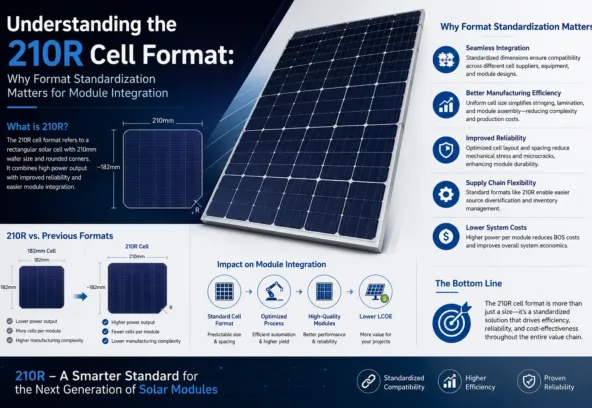
Format matters as much as technology. TOPCon cells come in various physical formats — and cell format compatibility with your existing module assembly line is often the deciding factor in supplier selection, not the underlying cell chemistry itself. (We cover this in detail in our piece on the 210R cell format.)
Production line compatibility. One reason TOPCon spread so quickly is that most existing PERC production lines could be upgraded rather than rebuilt from scratch. If you’re a module manufacturer evaluating new cell suppliers, ask whether their TOPCon cells are produced on modern, purpose-built lines or retrofitted PERC infrastructure — both can deliver to spec, but the consistency profile can differ.
TOPCon vs. the Alternatives
TOPCon sits in a specific competitive position: it isn’t the cheapest technology (that’s still largely PERC, where it remains in use), and it isn’t the highest theoretical efficiency ceiling (that title currently belongs to HJT and emerging back-contact architectures like ABC). What TOPCon offers is the best practical balance of efficiency, manufacturing cost, and production scalability available today — which is precisely why it captured the majority of the market in such a short window.
For module manufacturers building products for mainstream commercial and utility-scale markets, that balance usually matters more than chasing the absolute efficiency ceiling, where premium pricing often outpaces the performance gain.
Where PTECH Solar Fits
PTECH Solar manufactures n-type TOPCon solar cells in the 210R format at our facility in Düzce, Turkey. As a dedicated cell manufacturer — not a vertically integrated brand competing with our own customers for module sales — our focus stays entirely on cell quality, consistency, and supply reliability for module producers serving the US and global markets.
If you’re evaluating TOPCon suppliers and want to understand how format, manufacturing location, and supply chain structure affect your sourcing decision, our team is available to walk through technical specifications and sample availability.
This article is part of PTECH Solar’s technical resource series for module manufacturers and B2B solar buyers. For questions about our N-type TOPCon 210R cells, visit ptechsolar.com.