
For most of the 2010s, PERC was the default choice for solar cell production. By 2026, that’s no longer true. TOPCon now accounts for nearly 85% of global cell production, while PERC’s share has fallen to roughly 1-2% of shipments among major manufacturers. If you’re a module manufacturer still running PERC lines, or evaluating new suppliers, here’s what actually separates the two technologies — and whether switching still matters this late in the transition.
The Short Answer
TOPCon outperforms PERC on efficiency, temperature performance, and long-term degradation, at a manufacturing cost that’s now close enough to PERC that the efficiency gain almost always justifies the switch. PERC retains a narrow cost advantage in some markets, but that gap has been closing steadily since 2022.
Side-by-Side Comparison
| Factor | PERC (p-type) | TOPCon (n-type) |
| Typical cell efficiency | ~21-22% | ~23-25%+ |
| Temperature coefficient | Moderate | Better (lower power loss in heat) |
| Annual degradation rate | ~0.55%/year | ~0.25-0.35%/year |
| Bifacial/low-light performance | Limited | Strong |
| Production line compatibility | Mature, widespread | Compatible with upgraded PERC lines |
| Market share (2026) | ~1-2% | ~85% |
Why Efficiency Differences Compound Over Time
A 1-2 percentage point efficiency gap sounds small until you calculate it across a 25-year warranty period and a multi-megawatt installation. Lower degradation rates mean a TOPCon module is still producing meaningfully more energy in year 20 than a PERC module of equivalent starting capacity. For utility-scale buyers calculating levelized cost of electricity (LCOE), this difference shows up directly in their financial models — which means your module’s underlying cell technology affects how competitive your bid looks to their procurement team.
The Manufacturing Cost Question
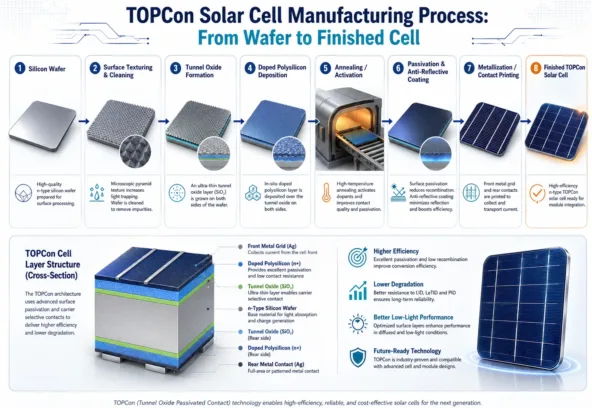
This is where PERC held its advantage the longest. TOPCon cells require additional process steps — particularly the formation of the tunnel oxide layer and doped polysilicon deposition — which historically added cost per watt compared to PERC’s simpler structure.
That gap has narrowed substantially for two reasons:
- Most TOPCon production runs on upgraded PERC lines, not entirely new infrastructure. The transition from PERC to TOPCon has largely been evolutionary — existing equipment and process know-how carried over, keeping capital expenditure lower than building net-new TOPCon-specific lines.
- Scale. As TOPCon production volume grew industry-wide, per-unit costs fell in line with typical manufacturing learning curves.
By 2026, the cost premium for TOPCon over PERC is small enough that, for the vast majority of module manufacturers, the efficiency and longevity gains outweigh the marginal cost difference.
Where PERC Still Makes Sense (Narrowly)
There are limited scenarios where PERC remains a reasonable choice:
- Budget-constrained projects where upfront capital cost outweighs long-term yield considerations
- Markets with very low electricity prices, where the LCOE advantage of higher efficiency matters less
- Existing inventory or supply contracts that haven’t yet transitioned
For nearly everyone else — particularly module manufacturers selling into the US, European, or other markets where buyers increasingly specify n-type technology in procurement requirements — PERC is becoming a legacy option rather than a competitive one.
What N-Type vs. P-Type Actually Changes at the Material Level
The core difference comes down to doping. P-type silicon (used in PERC) has boron added as the dominant dopant; n-type silicon (used in TOPCon) uses phosphorus. This changes how charge carriers behave inside the cell:
- N-type wafers have lower minority carrier recombination in the bulk material, independent of any surface passivation technology layered on top
- N-type cells are less sensitive to common impurities like iron and boron-oxygen complexes that degrade p-type performance over time
- This is part of why n-type cells show better long-term stability even before accounting for TOPCon’s additional surface passivation benefits
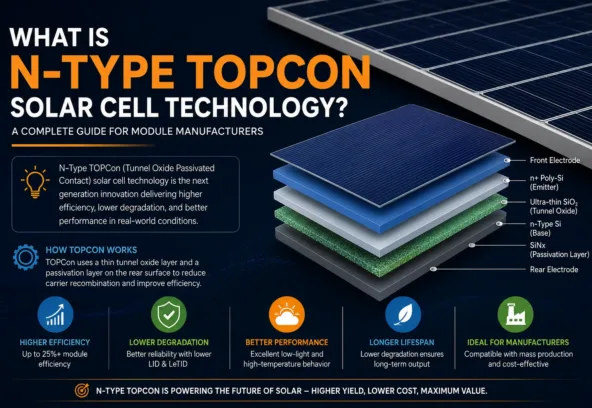
In short: TOPCon’s advantages come from two compounding sources — the n-type substrate itself, and the tunnel oxide passivation layered on top of it.
What This Means for Your Sourcing Decision
If you’re still buying PERC cells, the question worth asking isn’t whether to switch — most of the market has already decided that question — but how to manage the transition without disrupting existing production commitments. If you’re already sourcing TOPCon, the comparison that matters now shifts to supplier reliability, format standardization, and country of origin (especially relevant given current US trade policy on solar cell imports).
PTECH Solar’s Position
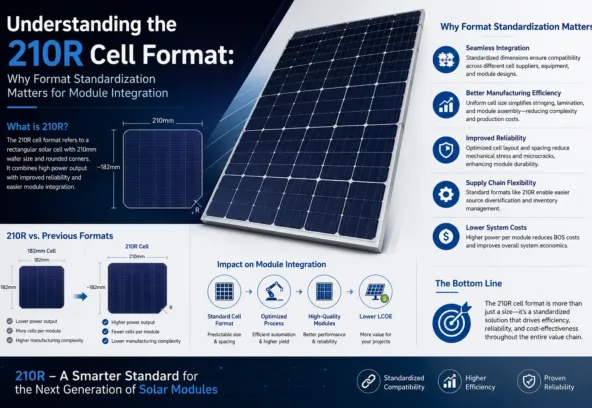
PTECH Solar manufactures n-type TOPCon cells exclusively, in the 210R format, from our facility in Düzce, Turkey. We don’t produce PERC cells — our entire production line was built around n-type technology from the outset, which means consistent quality without the legacy infrastructure constraints some larger, longer-established manufacturers carry from their PERC-era equipment.
For module manufacturers planning their technology roadmap for 2026 and beyond, we’re glad to provide technical documentation and samples to support your evaluation process.
This article is part of PTECH Solar’s technical resource series for module manufacturers and B2B solar buyers. For questions about our N-type TOPCon 210R cells, visit ptechsolar.com.